
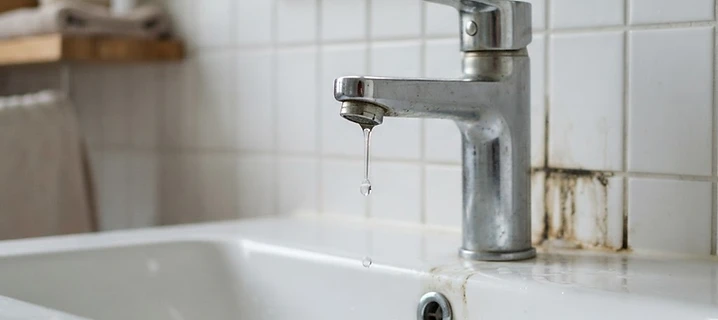
Why Bathrooms Are the #1 Leak Zone
More water moves through a bathroom than any other room in the house — through supply lines, drains, a toilet, a shower, and a tub. Any one of them can fail quietly and soak the wall cavity for weeks before you see a stain. The good news: the five most common culprits are all checkable in a single weekend, and most fixes take under an hour.
Fix 1: The Dripping Faucet (15 minutes)
A faucet that drips once a second wastes over 3,000 gallons a year — and it's almost always a worn-out cartridge or washer.
- Shut off the water under the sink (or the main if there's no shutoff).
- Remove the handle — usually a set screw under a decorative cap.
- Pull out the cartridge or stem and take it to the hardware store to match the exact replacement.
- Drop in the new part, reassemble, and turn the water back on.
Tip: Take a photo of the faucet brand and the old cartridge. Most stores can match it in minutes.
Fix 2: The Sneaky Shower Base Leak (30 minutes)
A cracked or poorly sealed shower pan leaks every time someone showers — and the water travels along the subfloor until it shows up as a ceiling stain in the room below.
- Inspect the caulk where the shower base meets the wall and floor. If it's cracked, peeling, or moldy, it's done.
- Scrape out the old caulk completely with a putty knife and clean the surface with rubbing alcohol.
- Apply a fresh bead of 100% silicone caulk (mildew-resistant) and smooth it with a wet finger.
- Let it cure 24 hours before running the shower.
If the leak persists after recaulking, the pan itself may be cracked — that's a pro job.
Fix 3: The Toilet Supply Line (10 minutes)
The braided supply line behind the toilet is the most common source of slow, hidden bathroom leaks. They corrode at the fitting and weep onto the floor — often behind the toilet where you never look.
- Feel the connection where the line meets the toilet tank. Damp or crusty mineral buildup = slow leak.
- Replace the line — shut off the wall valve, disconnect, and thread on a new braided line ($8–$15). Use a new rubber washer.
- Check the wall valve while you're there — if it doesn't turn smoothly, replace it before it fails.
Fix 4: The Grout and Tile Seal (45 minutes)
Water doesn't just leak through obvious cracks — it wicks through old, porous grout every time you shower.
- Inspect the grout lines for cracks, pits, or discoloration.
- Regrout any damaged sections with a matching sanded grout.
- Seal the entire shower floor and lower walls with a penetrating grout sealer — apply, wait, wipe. Re-seal yearly.
Fix 5: The Exhaust Fan That Isn't (20 minutes)
A bathroom without proper ventilation breeds mold in the wall cavity — the leak you can't see until it's structural.
- Turn on the fan and hold a tissue to the grille — if it doesn't hold the tissue, the fan isn't moving air.
- Clean the fan — pop the cover, vacuum the housing, and wipe the blades.
- Verify the duct actually vents outside, not into the attic. A vented-into-attic fan is worse than no fan — it dumps moisture where it rots the roof deck.
- Run the fan for 20–30 minutes after every shower, not just while you're in the room.
The Weekend Payoff
Spend one Saturday on these five checks and you'll catch 90% of bathroom leaks before they reach the drywall — and save yourself a far bigger repair down the road.