
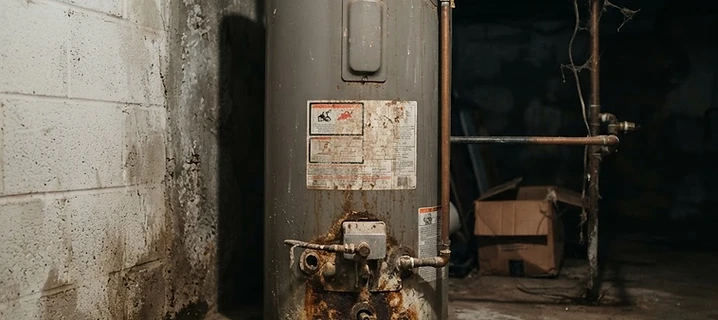
The Silent Failure Problem
Water heaters rarely warn you before they fail. One morning you step into a cold shower; or worse, you walk into the basement and find 40 gallons of water spreading across the floor. The average tank lasts 8–12 years, and once it crosses that line, you're on borrowed time. Knowing the age and the warning signs lets you plan the replacement on your schedule — not the plumber's emergency rate.
Step 1: Find the Age
Every tank has a serial number sticker (or a rating plate) that encodes the manufacture date. The format varies by brand, but most use the first four characters:
- The first letter is the month (A = January, B = February, etc.)
- The next two digits are the year
For example, a serial starting "C19…" means March 2019. Some brands (A.O. Smith, Rheem, Bradford White) use slightly different codes — check the manufacturer's guide or search "water heater age decoder" with your brand. If your tank is over 10 years old, start planning now.
Step 2: Watch for the Warning Signs
Catch these early and you'll avoid the flood:
- Rusty or discolored hot water — the tank is corroding from the inside. (Cold water is clear? It's the tank, not your pipes.)
- Rumbling or popping sounds — sediment has built up at the bottom. It's not dangerous yet, but it shortens the tank's life and wastes energy.
- Water pooling near the base — a hairline crack in the tank wall. This is the final warning before a full failure.
- Hot water that runs out faster — sediment is displacing your hot water capacity.
- A metallic or rotten-egg smell — can indicate a failing anode rod or bacteria in the tank.
Step 3: Do the Preventative Maintenance
Two cheap habits add years to a healthy tank:
- Flush the tank once a year — connect a hose to the drain valve, shut off the power/gas and cold water, and let it empty until the water runs clear. This clears the sediment that causes the rumbling and shortens the tank's life.
- Check the anode rod every 2–3 years — this sacrificial metal rod corrodes so your tank doesn't. If it's more than half eaten, replace it (about $20–$40). It's the single best way to extend a tank's life.
Step 4: Choose the Replacement Window
Don't wait for the flood. If your tank is 10+ years old, replace it on your terms:
- Compare tank vs. tankless — tankless units cost more upfront but last ~20 years and never run out of hot water. They're ideal for smaller Long Island homes or additions.
- Size it right — a family of four typically needs a 50-gallon tank; tankless is sized by flow rate (gallons per minute), not capacity.
- Check for rebates — Long Island Power Authority (LIPA) and National Grid often offer rebates for high-efficiency and heat-pump water heaters.
- Schedule in the off-season — plumbers are slower in late winter/early spring, so you'll get faster scheduling and sometimes better pricing.
The Takeaway
Find the age, flush yearly, watch the signs. A planned $1,200 replacement beats a $3,000 emergency cleanup every time.