
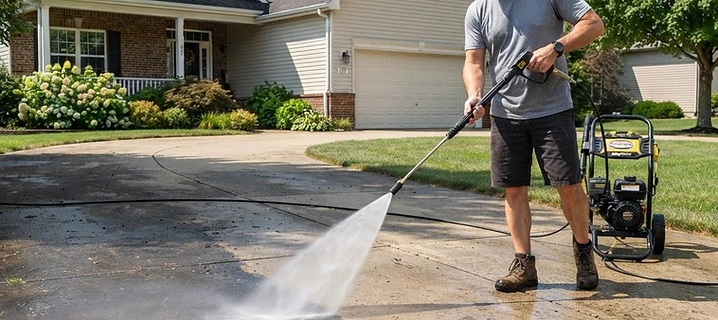
Why Pressure Matters
A pressure washer is one of the most useful — and most destructive — tools a homeowner can own. The wrong nozzle at the wrong distance can etch vinyl siding, blast mortar out of brick joints, gouge decking, and force water behind your home's cladding where it causes hidden rot. The secret isn't more power; it's the right pressure for the right surface, paired with the right technique.
Know Your Numbers: PSI and GPM
- PSI (pounds per square inch) is the force that breaks the dirt loose.
- GPM (gallons per minute) is the volume that washes it away.
- A machine with high PSI but low GPM will scar surfaces. For most home jobs, 2,000–2,800 PSI is plenty. Anything labeled 3,000+ is commercial-grade and risky on residential siding.
Safe Pressure by Surface
| Surface | Max PSI | Notes | |---|---|---| | Vinyl siding | 1,500–2,000 | Use a wide fan tip; never aim up under the siding laps | | Wood decking | 500–1,200 | Use a dedicated deck tip; keep the wand moving | | Concrete / pavers | 2,500–3,000 | Use a 25° tip; hold 8–12 inches away | | Brick / mortar | 500–1,000 | Low pressure only — you can blow mortar out of the joints | | Stucco | 1,000–1,500 | Fragile; test a small hidden area first | | Vehicles | 1,200–1,900 | Use a 40° tip; never closer than 12 inches | | Windows | Hand-wash | Pressure washing can shatter glass and break seals |
The Four Nozzle Colors
Most machines come with four color-coded tips — know them before you pull the trigger:
- Red (0°) — a single laser stream. Never use it on a home exterior. It cuts like a knife.
- Yellow (15°) — narrow fan. For stubborn concrete stains only.
- Green (25°) — the general-purpose tip. Most of your work happens here.
- White (40°) — wide, gentle fan. For siding, decking, and vehicles.
- Black — low-pressure, soap-dispensing tip. For applying detergent.
Technique: The Rules That Prevent Damage
- Start far away and move closer — test on an inconspicuous spot at 18 inches, then close the distance until the dirt lifts. Never start close.
- Keep the wand moving — holding still in one spot gouges the surface, even at low pressure.
- Work from the top down on siding so dirty water doesn't streak clean areas.
- Never angle the spray upward under siding, shingles, or flashing — you'll force water behind the waterproof barrier.
- Use detergent, not force — a good house wash mix (sodium hypochlorite + surfactant) does 80% of the work. Let it dwell 5–10 minutes, then rinse gently. The pressure is just the rinse.
- Protect plants and electrical outlets — wet them down before and after, and cover outlets with tape.
When to Call a Pro
If your home is two stories, has delicate stucco, or you're dealing with heavy roof staining, a professional soft-wash service is safer and often cheaper than renting a machine that can do real damage. Soft washing uses low pressure and specialized cleaners — it's the right tool for siding and roofs.
The Takeaway
Match the pressure to the surface, use the widest tip that gets the job done, and let the chemicals do the heavy lifting. Your home will be cleaner — and intact.